“A rare and rigorous panorama of the fashion industry in all its complexity. A book that does not simplify. And that is exactly why it is essential.”Fatine Layt · Publisher & CEO, A Group Curated By
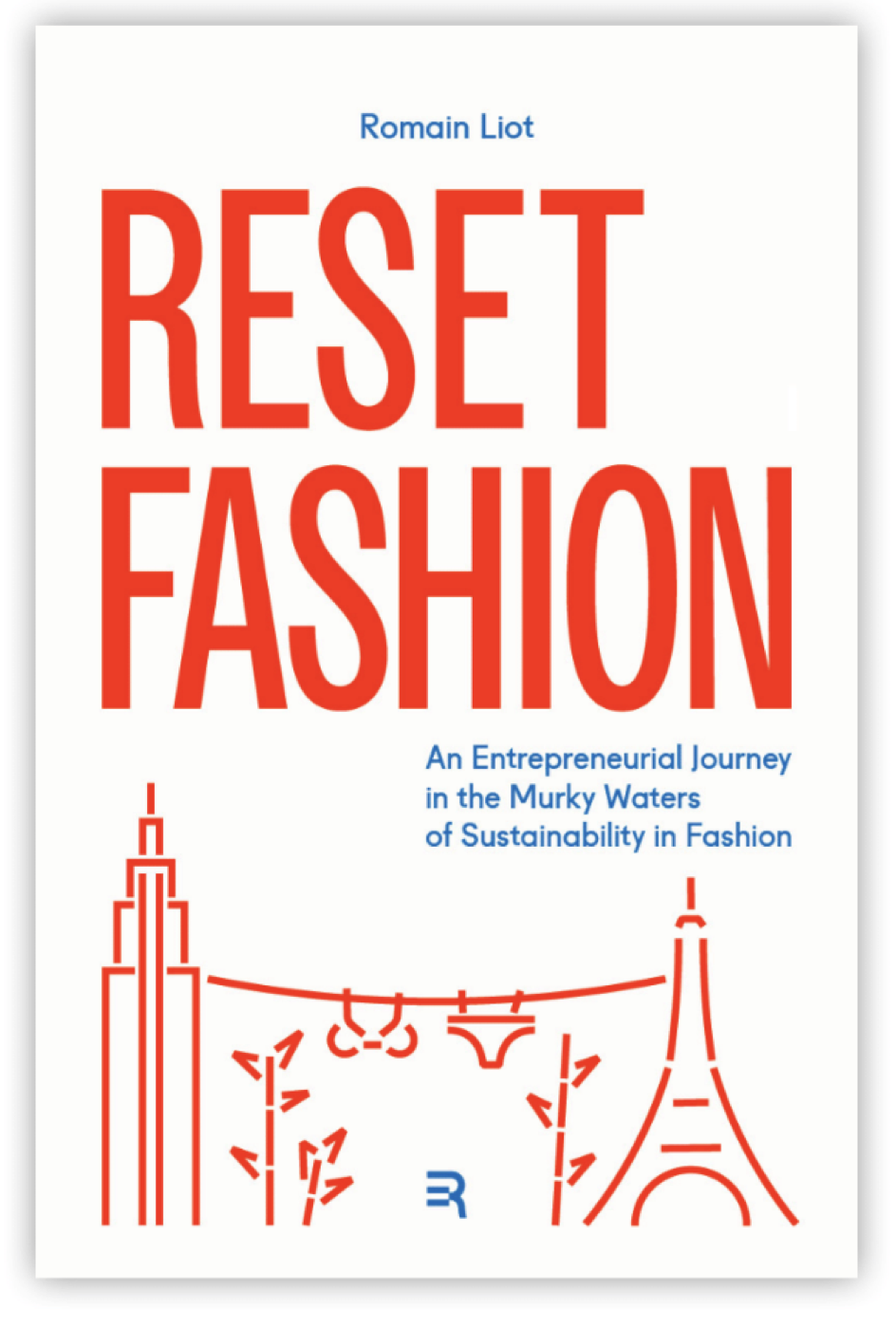
Fashion sits at the crossroads of creativity, industry, and global consumption — and at the center of one of the most complex sustainability challenges of our time. For more than a decade, the industry has promised transformation. Yet emissions continue to rise, progress remains fragmented, and many initiatives stall before reaching scale. Why?
In Reset Fashion, Romain Liot takes us inside the machinery of fashion to understand why so many well-intentioned initiatives fail when they meet economic reality.
And in doing so, real solutions begin to appear.
The Central Thesis
“Sustainability in fashion is not failing for lack of ideas — but for lack of systems able to absorb them.”
They Talk About It
“A rare and systemic analysis of the fashion industry. An essential book.”Frédéric Godart · Professor at INSEAD
“Reset Fashion has the potential to change the conversation around sustainability in fashion. Finally!”Marci Zaroff · Eco Fashion pioneer
“A field report rather than a theoretical manifesto. No incantations. No corporate doublespeak.”Victoire Satto · Founder of The Good Goods
The Argument
The Reset Fashion Bet
Conviction Was Never the Problem
The industry multiplied grand declarations and ambitious pacts. Signatures came quickly. Collective execution did not.
The failure does not come from a lack of conviction, but from the absence of mechanisms capable of carrying good intentions through cost structures, fragmented supply chains, and organizational inertia.
“A whispered bet that basically says: our industry that unintentionally damaged the planet it depended on can change faster than anyone imagines.”
Proof Through Action
Game Changers
Eight organizations building the infrastructure that allows the best ideas to survive economic reality.
01Transparency

What They Solve
Clear Fashion turns complex product and company data into information everyone can understand. Its approach combines rigorous methodology with accessible tools.
Why It Matters
Transparency changes a system only when it truly informs demand, rather than adding one more index to the existing jungle.
Official Website02Carbon Data

What They Solve
Carbonfact provides apparel and footwear teams with product-level carbon data and tools for reporting and reduction.
Why It Matters
Measurement becomes a lever when operators can use it to change what they design, buy, and transport.
Official Website03Chemistry

What They Solve
EverDye develops bio-based pigments that dye textiles at room temperature on existing machinery. The process reduces the heat, water, and chemistry required.
Why It Matters
The solution reduces emissions without requiring factories to rebuild their industrial equipment or customers to sacrifice price or color.
Official Website04Climate Tech

What They Solve
ThermoTune combines sensors, thermodynamic modeling, and AI planning to optimize dyehouse boilers rather than replace them.
Why It Matters
Invisible operational innovation can reduce emissions while improving supplier economics.
Official Website05Traceability

What They Solve
CommonShare standardizes fragmented supply-chain, certification, and product information to make data reliable and usable.
Why It Matters
Traceability is not a dashboard, but an architecture of trust in which sharing becomes safer than hiding.
Official Website06Open Infrastructure

What They Solve
Open Supply Hub maps production facilities in an open, shared registry, replacing anonymous factories and incompatible proprietary lists.
Why It Matters
A shared map gives carbon, traceability, and sourcing tools a reliable entry point into the real system.
Official Website07Cross-Disciplinary Education
ENAMOMA–PSL
What They Solve
ENAMOMA brings together fashion, engineering, and management within PSL University. The chair prepares talent able to work across the disciplines required for transition.
Why It Matters
Complex systems cannot be transformed by a single expert function: science, business, and culture must be connected.
Official Website08Data Infrastructure

What They Solve
Parley enables organizations to share and verify impact data through a decentralized exchange without imposing a single platform.
Why It Matters
Shared identifiers and reusable evidence can replace duplicated audits with reliable, interoperable data.
Official WebsiteThe Entry Point
The Book
01
The Unintended Consequences of Good Intentions
Why good intentions create unintended consequences.
- The Mirage of Sustainable Fashion Growth
- The Cost Trap
- The Aesthetic Trap
- The Capsule Collection Trap
- The Circle That Never Closes
- Index Jungles
- The ESG Drift
02
Inside the Machinery of Fashion
The real forces reshaping the industry.
- The Great Fashion Divide
- Chinese Brands: Villain or Champion?
- When the Algorithm Becomes the Merchant
- Mixed Signals
- Regulatory Instability
- When Investors Rewrite the Rules
03
What Fashion Should Do Now to Turn the Tide
Actionable leverage points.
- Start With the Cash-Positive Levers
- Look Up: It Is All About Scope 3!
- Traceability: Seeing the System
- The New Engineering Levers
- Collaboration
- The Bamboo Organization
- The Reset Fashion Bet
Topics Explored
The major questions explored across the book’s 28 chapters, organized in three parts.
Part 1 — The Unintended Consequences of Good Intentions
- Chapter 1 — The Mirage of an Inexorable Growth of Sustainable FashionA Multifaceted but Attractive Concept · The Decade of Hope · The ESG Dividend Dream · The Mirage Starts to Fade · The Unintended Consequence
- Chapter 2 — The Cost TrapThe Green Premium Myth · The Cost Cascade and the Green Penalty · The Middle-Ground Dilemma · Inside the Trap · Adore Me’s Cost Discipline · The Unintended Consequence
- Chapter 3 — Sobriety Makes Sense Until It Meets the WorldProduction Maths · Consumer Resistance · Spins, Baby, Spins! · Social Backlashes · A New Abundance Paradigm?
- Chapter 4 — The Aesthetic TrapA Narrow Visual Code · When Morality Became a Mood Board · Meet Gynger · The Unintended Consequence
- Chapter 5 — The Capsule Collection TrapThe Illusion of Movement · How the Trap Works · Why Capsules Hardly Scale · Adore Me’s Slip into the Pilot Trap
- Chapter 6 — The Circle That Never ClosesThe Mirage of Closed Loops · The Rise of Open Loops · Chains of Dependencies · The Coordination Gap
- Chapter 7 — Falling for the SpotlightsInside Fashion’s Glamorous Sustainability Groups · Collective Action, Individual Comfort
- Chapter 8 — Index JunglesWhen Measuring Becomes an Industry · The Credibility Paradox · Minimum Compliance, Maximum Confusion · The AIM Score
- Chapter 9 — Experts versus OperatorsThe Paradox of Capability · Organizational Absorption · The Consultant as Interpreter
- Chapter 10 — The ESG DriftFrom Sustainability to ESG · When Process Replaces Intent · The B Corp Lesson
Part 2 — Inside the Machinery of Fashion
- Chapter 11 — Mirror, Mirror on the Wall, Who Is the Fairest of Them All?What Godart Reveals · The Symbolic Engine Always Outruns the Industrial One
- Chapter 12 — When the Crown Feels the WeightThe Trust Recession · Luxury’s Untapped Power · Proof That Luxury Can Act
- Chapter 13 — The Great Fashion Divide: Inside an Atomized IndustryA System of Shared Dependence · The Human Faces of Fragmentation · Structural Inertia
- Chapter 14 — Fashion in a Fragmented WorldWhen Efficiency Turns into Fragility · The Tariff Whiplash · Hardened Reality
- Chapter 15 — Chinese Brands: Villain Today, Soon Sustainability Champions?The Governance Problem · What Shein Nevertheless Showed · Why the Next Disruption Will Come from China
- Chapter 16 — The Tech Vortex: When an Analog Industry Meets a Digital WorldA Weak Digital Backbone · The Innovator’s Vortex · From Vortex to a Lingua Franca?
- Chapter 17 — When the Algorithm Becomes the MerchantFrom Storefront to Feed · The New Rent · Fashion’s Next Merchant: Agentic AI
- Chapter 18 — Mixed Signals: Decoding the New Logics of Fashion ConsumptionSustainability as Desire, Sustainability as Reality · The Many Selves of the Modern Consumer
- Chapter 19 — Regulatory Instability: When the Rules Shift Faster Than the SystemEuropean Momentum and Reversals · What Effective Regulation Looks Like · Algorithmic Transparency
- Chapter 20 — When Investors Are Rewriting the RulesFrom Risk Avoidance to Impact Investing · Where Finance Becomes Governance · Accountants as Future Sustainability Warriors
Part 3 — What Fashion Should Do Now to Turn the Tide
- Chapter 21 — Start With the Cash-Positive LeversEfficiency Is the First Decarbonization Factor · The Inventory Sudoku · Cash Management Is a Good Climate Strategy
- Chapter 22 — Look Up: It Is All About Scope 3!ThermoTune · EverDye · H&M’s Removal of Coal · Electrification · Biodiversity
- Chapter 23 — Traceability: Seeing the System Before You Change ItLCAs Describe the Landscape; Traceability Lets You Walk It · Secrecy and Shared Systems
- Chapter 24 — The New Engineering Levers of SustainabilityNike · Decathlon · Uniqlo · Producing What the Market Actually Needs
- Chapter 25 — Collaboration: The Bridge Fashion Struggles to BuildOpen Supply Hub · ENAMOMA-PSL · Billie Eilish × Marci Zaroff · The Parley Protocol
- Chapter 26 — A Transformation StoryRadical Honesty · When Transparency Becomes Structure · Transformation Requires a System Reset
- Chapter 27 — The Bamboo OrganizationDepth, Breadth, and Judgment · Capabilities Move Systems. Purpose Keeps Them Moving
- Chapter 28 — Purpose in a Disoriented IndustryPurpose Enters the Operating Code · Adore Me · MAS Holdings · Patagonia · The Reset Fashion Bet
- Conclusion — Time to Reset FashionSolutions Are Emerging to Reset Fashion
Inside the Machine
The Author

Foreword Author

Foreword by René Rohrbeck
The Foreword
Many books have been written about sustainability in fashion. Very few have been written from the inside, and even fewer with analytical rigor. What distinguishes this book is its point of view: not detached observation or moral commentary, but lived experience grounded in responsibility — for margins and payrolls, suppliers and strategic choices, and the compromises imposed by economic constraints.
In his work on strategy, foresight, and net-positive business, René Rohrbeck studies why most sustainability initiatives struggle to scale. The pattern is familiar: good intentions collide with fragile economics, fragmented systems, misaligned incentives, and organizational fatigue.
“Too often, sustainability remains symbolic before it becomes structural.”
Reset Fashion addresses that gap directly, not theoretically but empirically. Romain Liot’s journey — particularly the transformation work at Adore Me — brings concrete field data to the sustainability debate: not proof that transformation is easy or linear, but that it is possible without retreating into niche positioning, moral exceptionalism, or economic denial.
Sustainability is not treated as a marketing argument. It is introduced as a constraint built into price structures, demand, and global supply chains — in other words, a design and governance constraint. The story embraces false starts, gradual readjustments, and hard-won successes.
Progress comes not from assertion, but from measurement, transparency, and capability building. It also requires accepting that most consumers will not pay a green premium: meaningful change must work within competitive cost structures.
“Positive trajectories do not emerge from declarations. They emerge from capabilities.”
Systems do not change through moral conviction alone. They change when new logics prove more robust than old ones — economically, operationally, and culturally. This book speaks to readers tired of slogans but not of responsibility, and to leaders who refuse to retreat.
If sustainability is to move from discourse to reality, it will not happen through perfection or posture. It will happen through those who engage in the field and do the hard work. After reading this book, René Rohrbeck puts it plainly: he believes in the Reset Fashion Bet. Fashion can be reinvented — and this time, it just might work.
Read Before Going Further
Discover Excerpts from the Book
Enter Reset Fashion through the book’s introduction and the chapter on the cost trap — two texts that establish the diagnosis and confront sustainability with economic reality.
01Introduction
Contrary to the general spirit today, sustainability has not failed. It might be worse: it has been set aside.
Across industries, the retreat is quiet but unmistakable. ESG reports are shelved, postponed, or left online with last year’s date and a discreet tag: “under review”. Editors tell PR teams, almost apologetically: “readers don’t click on sustainability anymore.” The language has shifted — from ambition to fatigue, from urgency to caution. What once carried moral weight now feels like homework.
That fatigue would already be troubling on its own. It becomes intolerable when set against the climate trajectory.
The planet has never been in worse health. And the fashion industry — to which I have devoted a large part of my professional life — has made remarkably little progress over the past twenty years. Instead of shrinking, as required by the Paris Agreement, fashion’s carbon emissions and other negative externalities continue to rise. Not slightly. Not marginally. Structurally, year after year.
But this is only part of the story. At the same time, the industry itself has been profoundly destabilized. Its economics have shifted, its supply chains stretched, its internal dynamic distorted. And despite all the former hype surrounding “sustainable fashion”, there are remarkably few examples of companies operating at scale that have succeeded by placing sustainability at the core of their business model.
In other words, we are not on the right trajectory. And something, somewhere went obviously wrong. Actually, a lot of things in a lot of places went wrong.
I use we deliberately. We are all consumers. And many of the people who will read this book are also fashion professionals. We are in the same boat — a boat that is pitching violently — and we could all point fingers at one another. In the end, the bill will be shared. And it will be steep.
This is why I decided to tell my story and to share the takeaways of this journey.
This story is firstly the one of an insider: a fashion entrepreneur who, with a group of friends, built Adore Me, a lingerie brand, from a scrappy New York startup in 2012 to joining Victoria’s Secret & Co. in 2023 in the largest direct-to-consumer brand acquisition in fashion history. That deal mattered not only financially but symbolically as well: joining forces with one of the most iconic names in fashion to push the intimate category toward a more inclusive, tech-driven, and sustainable future.
It is also the story of an outsider. I never quite fit the mold of the New York Garment District and Adore Me was an outlier from the beginning — a rare mix of talent, boldness, and purpose. Most of us were not “fashion people”, nor fascinated by fashion’s spotlights. We came with fresh eyes, data-first instincts, and a technology-driven approach to almost everything. That outsider mindset was our edge. It allowed us to question assumptions, experiment relentlessly, and sometimes succeed where traditional players barely dared to try.
This is also the story of a sustainability enthusiast — not born from ideology but from proximity. It comes from years of meeting fascinating people all over the world who were trying, often quietly and imperfectly, to make things better in their own way. It stems from seeing how much intelligence and goodwill already exist inside the system, and recognizing how rarely it is allowed to compound.
Becoming a father changed the texture of the question. Climate change stopped being an abstract trajectory and became a temporal one: not “what kind of industry are we aspiring to?” but “what kind of world am I handing over?”. It sharpened my intolerance for symbolic progress and strengthened my appetite for things that actually work.
At Adore Me, this combination of exposure and urgency pushed us to take risks early. We pursued B Corp certification at a time when it was still a marginal movement in fashion. We invested in data-centric decision-making long before sustainability dashboards became fashionable. We built numerous tools, experimented with product-level impact accounting, and attempted several industry firsts. Of course, we also made mistakes. But those failures were not wasted. They revealed friction points no report could capture and taught us something essential: transition is not blocked by a lack of solutions, but by the absence of systems capable of absorbing them.
And finally, this is also the story of a rising anger. Frustration at the distance between the urgency of the situation and the pace of real change. Skepticism toward theories that sound profound but fall apart in real operational and economic terms. Rage at watching consequences settle in slowly but relentlessly, even as the conversation circles endlessly around hollow intentions.
Over time, I became uneasy with the gap between elegant sustainability narratives and the messiness of implementation. Too many frameworks assume away cost structures, ignore supply-chain physics, or underestimate organizational inertia. Too many slogans confuse moral clarity or Manichean alignment with practical effectiveness.
What troubles me most is not that progress is hard — that was always expected — but that so much energy has been invested in the wrong places. In declarations rather than design. In promises rather than plumbing. In visibility rather than viability. The result is not only disappointment but fragility: teams and customers grow increasingly disillusioned, and a growing cynicism mistakes frustration for realism.
I do not claim to hold the blueprint for a peaceful fashion industry transition. But I am convinced of this: the changes required go far beyond well-meaning yet ineffective slogans — they demand much more. They are more uncomfortable than most organizations realize. Sustainability, if it is to matter, must be built into the operating system — not layered on top as a moral accessory.
This book is written by a builder, not a preacher. You will find real projects tested within Adore Me and other fashion companies as well as the broader lessons they reveal about what it actually takes to move this industry.
And yet, despite everything, I still believe there is a path forward.
Fashion can reinvent itself and perhaps, along the way, inspire other industries to do the same. That is what this book is about.
Part One examines how good intentions of the industry went wrong — moral postures, capsule collections, ESG promises, and other well-meaning efforts that produced unintended consequences.
Part Two dives into today’s fashion ecosystem — fragile, fragmented, full of contradictory signals — and the disruptions already reshaping it.
Part Three explores how the industry should act now: cash-positive levers, technology, smarter collaboration, and organizational resets.
This is not a manifesto. It is a field guide — messy, grounded, and rooted in lived experience. A diary of experiments and small breakthroughs that others can hopefully build upon.
Fashion, with its resources, creativity, and visibility, has the potential to move faster and better, but only if it stops pretending we are already heading in the right direction and steps out of its comfort zone.
This book is for anyone who wants to look at the system with clear eyes, to understand why it is stuck, and to explore how we might improve it — together.
It is now time to reset fashion.
02The Cost Trap
In fashion, like in many other industries, cost is central.
It is the quiet metric behind every product, every runway, every headline campaign — the invisible engine of the industry’s survival. And yet, amid the grand conversation about transformation, purpose, and innovation, the word “cost” almost never appears. You will hear “impact”, “mission”, or “responsibility”, but rarely “COGS”. That omission is not accidental; it conceals the industry’s most uncomfortable truth. Sustainable fashion is also stalling because the economics generally do not add up and the business model is not working yet.
COGS: Cost of Goods Sold, the accounting cost of a product.
The Green Premium Myth
“Green premium” is the belief that consumers would willingly pay more for sustainable products. The logic was that cleaner products — either for your health or for the planet — would command higher prices that consumers were willing to accept.
But the numbers never really supported that optimism. Across surveys and market studies, consumers consistently declared that they cared about sustainability, that they wanted to “vote with their wallet”, and that they were ready to pay more — but “more” usually meant a modest 3 to 5%. Beyond that, good intentions faded.
The Cost Cascade and the Green Penalty
As brands expected consumers to ultimately pay more, they themselves became willing to invest more in their own production costs, in particular to source better components for the planet. Many brands therefore accepted higher raw-material prices, longer lead times, or complex certifications. The assumption of a green premium justified inflated COGS. Except this inflated cost turned out much higher than the green premium accepted by most customers.
What began as a hopeful equation therefore turned into a structural trap: a self-reinforcing cycle in which companies spend more to do better and the market refuses to reward this. The green premium quietly transformed into a green penalty.
The Middle-Ground Dilemma
Luxury brands can better absorb extra costs generated by better raw materials. Their high margins, control over production, and ability to charge a premium for craftsmanship allow them to experiment without fear. Sustainability fits naturally within their narrative of quality, heritage, and scarcity.
At the other end of the spectrum, a few emerging mission-driven brands embedded responsibility within their identity from day one. Their customers expected to pay more, and their limited scale made that easier. A handful of pioneers, like Patagonia or Allbirds, managed to build lasting loyalty around purpose and quality. They became examples that a conscious business was possible.
But between these two extremes lies the vast middle ground — the part of the industry where most people work and where most products are made — and it is here that the green penalty bites hardest. Mainstream brands operate under relentless economic pressure: fierce competition, globalized sourcing, permanent discounting, thin margins. They cannot raise prices without losing volume, nor can they compromise ethics without losing reputation. It is precisely this middle — the segment big enough to change the world — that is least equipped to afford extra costs or missing sales.
Inside the Trap
I once shared a panel on sustainable fashion with the CEO of a mid-market, trendy brand. She told me that 10% of her assortment used sustainable materials. Those products cost more to make but could not be priced higher, so the margin was thinner. “If this segment scales to 25% of total sales,” she said, “my business model breaks.”
That single sentence captures fashion’s contradiction: sustainable brands that are not financially sustainable. Large corporations face a version of the same problem. Surrounded by layers of stakeholders and short-term KPIs, they resist anything that threatens quarterly returns. So many turn to sustainability hacks: a collection made from recycled nylon, a marketing partnership with an NGO, a glossy report. Enough to demonstrate awareness, not enough to transform practices in depth.
These gestures are sometimes cynical, but this is rare. More often, they result from genuine goodwill colliding with economic gravity. But the outcome is the same: a cycle of green rhetoric funded by shrinking margins and growing frustration.
Adore Me’s Cost Discipline
At Adore Me, we learned this lesson the hard way. We were part of that middle ground — neither luxury nor mission-brand — and we knew our customer well. The typical cost-conscious girl next door was looking for beautiful lingerie at our $39.95 fair price. She might have appreciated sustainability, but she was not going to pay a premium for it.
So, we made an early, deliberate decision: no green premium.
If we wanted to make a difference, it had to happen within our existing price points. That constraint became our discipline. We re-engineered materials, pushed suppliers to innovate, optimized energy use and logistics, automated inventory to avoid waste — anything that could offset the higher costs of better production. Through trial, error, and iteration, we learned to move forward without raising prices or losing margin on sustainable products, and therefore make them economically viable.
Somewhere along the way, we realized that this was the real frontier of sustainability: not finding ways to charge more for sustainability but finding ways to deliver it for the same price.
The Unintended Consequence
The fashion industry’s initial approach — upgrading to more expensive raw materials to offer greener alternatives — ultimately failed. The math did not add up between the green premium acceptable to the bulk of customers and the extra costs incurred.
But instead of re-engineering their cost structures or internal processes, brands switched to symbolism. They replaced sustainability progress with narrative. As a result, a movement that began as an urgent call for change evolved further into a contest of claims and slogans.
Fifteen years into fashion’s sustainability awakening, cost remains the elephant in the fitting room. As long as the economics of responsibility are built on wishful economic equations, the industry will keep circling the same paradox and applauding progress it cannot sustain.
Read Before You Buy
To receive free chapters from Romain Liot’s Reset Fashion, simply enter your email below.
Your address will only be used to send the excerpt and occasional Reset Fashion updates.